The Chancellor delivered the Budget on 28 October 2026. As expected, the business rates measures were focused on the high street, with a substantial package of support for retail, hospitality and leisure (RHL) businesses in England from 1 April 2027.
The government states that, taken together, RHL businesses will see their rates frozen in real terms, reduced or cut to zero. Half of all RHL properties will pay no business rates at all, and around 110,000 will see their bills fall next year.
Outside the RHL sector the changes are more limited. The Budget does not announce any change to the standard multipliers or to the timing of the 2029 revaluation. However, the Budget confirms that Valuation Tribunal appeal fees will be abolished, introduces new anti-avoidance measures, signals future support for infrastructure, and moves further towards local retention of business rates.
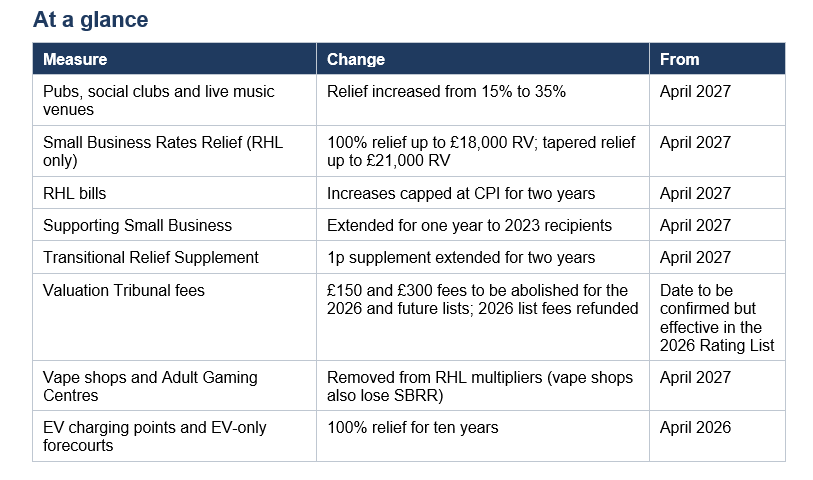
Support for retail, hospitality and leisure
• Pubs, social clubs and live music venues: relief increases by 20 percentage points, from 15% to 35%. The government estimates an average saving of over £3,000 per pub. The largest live music venues (rateable value of £1 million or more) are excluded from the increase but keep the existing 15% relief.
• Small Business Rates Relief: for qualifying RHL properties, the threshold for 100% relief rises from £12,000 to £18,000 rateable value, and the tapered relief threshold from £15,000 to £21,000. Around 70,000 more businesses will pay no rates, including about 3,500 pubs, 3,900 restaurants, 2,200 cafés and 1,700 hairdressers and beauty salons.
• Two-year real-terms freeze: bill increases for qualifying RHL properties are capped at CPI in 2027/28 and 2028/29. The cap does not apply to increases in rateable value from improvements, or to the loss of other reliefs (such as improvement relief or hardship relief) after 1 April 2026.
• Supporting Small Business: the 2026 scheme is extended for one year to ratepayers who received 2023 Supporting Small Business relief, protecting around 37,000 ratepayers.
The relief levels and thresholds will be kept under review alongside the 2029 revaluation.
How the package is funded
Part of the cost falls on other ratepayers. The 1p Transitional Relief Supplement is extended for a further two years from 1 April 2027. It is paid by properties whose bills fell at the 2026 revaluation, or whose increases are below the Transitional Relief and Supporting Small Business caps. Many industrial, office and infrastructure properties that fared comparatively well in 2026 will therefore keep paying more to help fund the high street.
The remainder is funded outside business rates, through an increase in Machine Games Duty on higher-stake machines and by requiring online marketplaces to collect VAT on behalf of UK sellers. The government also says it will continue to explore how business rates could better target online retailers.
Appeals
The government will abolish the £150 and £300 fees charged by the Valuation Tribunal for non-domestic rating appeals in England. This will apply to the 2026 rating list and future lists, and fees already paid on 2026 list appeals will be refunded. The date this takes effect has not yet been confirmed. This is welcome news for ratepayers, removing a cost barrier to appeal, particularly on lower-value cases.
Avoidance and reliefs withdrawn
• General Anti-Avoidance Rule: a new anti-avoidance rule for business rates will be introduced as soon as possible, following consultation on its design.
• Avoidance litigation: from April 2027, the government will reimburse local authorities’ external legal costs where they lose a case challenging avoidance that tests a point of law.
• Vape shops and Adult Gaming Centres: from April 2027 both lose access to the lower RHL multipliers, and vape shops also lose Small Business Rates Relief.
• Empty properties: no changes have been made. Following mixed responses to the Business Rates and Investment Call for Evidence, the government will engage further on how to encourage the reoccupation of empty properties.
Infrastructure
The Budget recognises that exceptional increases in rateable values can create particular challenges for strategically important infrastructure with long-term investment horizons. The government will legislate to provide further support for those most acutely affected, such as airports, once the current transitional relief scheme expires. No further detail has been given at this stage.
Electric vehicle charging
The previously announced 100% relief for eligible electric vehicle charging points and EV-only forecourts is included in the Budget costings, running for ten years from 1 April 2026.
Local retention and devolution
• From April 2027, Mayoral Strategic Authorities will receive a 20% share of locally retained business rates, plus a permanent 20% share of growth in their areas.
• The government intends local and regional government to retain 100% of business rates income by the end of the decade.
• New Business Rates Retention Zones are planned for Greater Manchester, East Midlands, Hull and East Yorkshire, Liverpool City Region, Tees Valley, West of England, North East, York and North Yorkshire, and the Greater London Authority. Within these zones, 100% of growth above an agreed baseline can be retained for 25 years.
• The Mayor of London will be able to establish a successor to the Elizabeth Line Business Rates Supplement.
Summary
This Budget delivers meaningful support for the high street but offers little for ratepayers outside the RHL sector, many of whom will continue to contribute through the Transitional Relief Supplement. The removal of tribunal fees is a positive step for all ratepayers, and the commitment on infrastructure is welcome, although the detail is still to come.
If you would like to discuss how the Budget affects your property or portfolio, please get in touch with the team at Dunlop Heywood.